
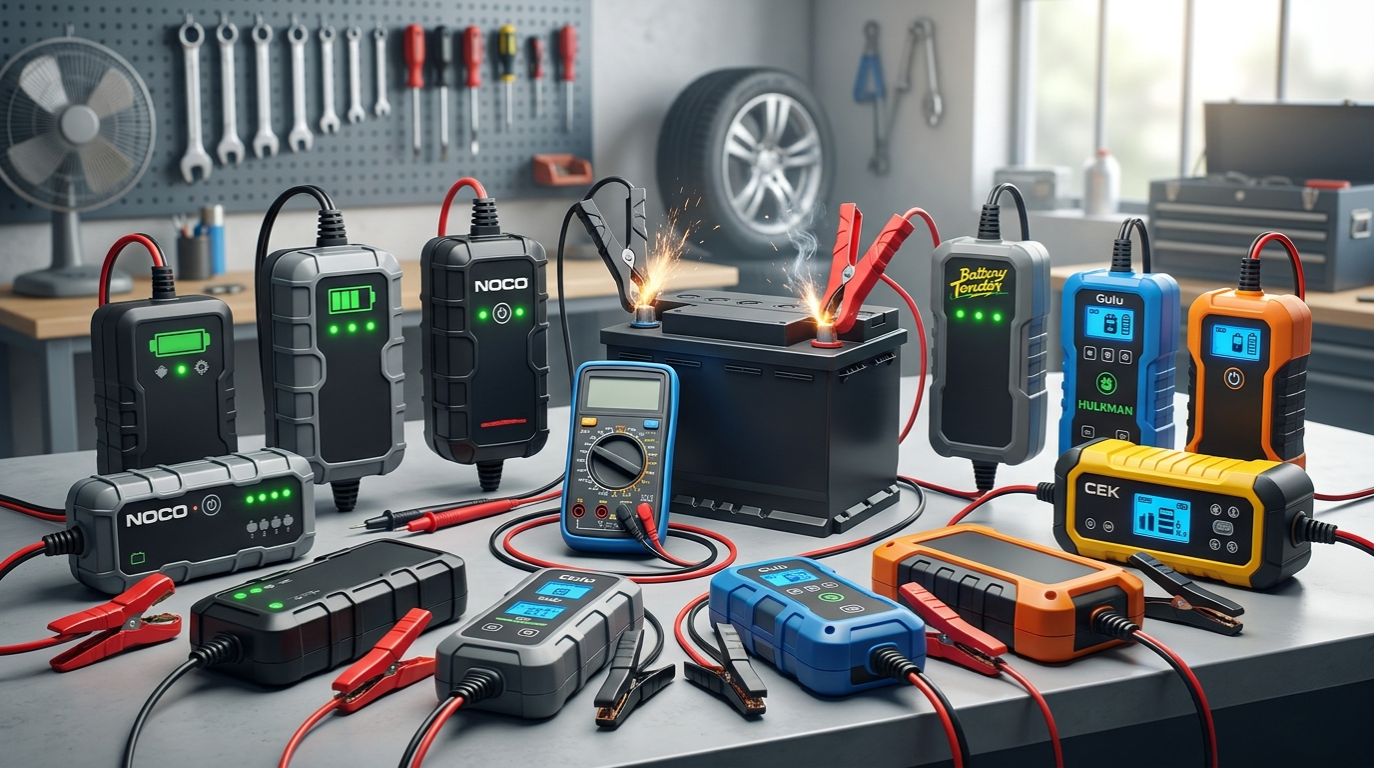
Most Hyped Car Battery Chargers
Why Your «Smart» Car Battery Charger Might Be Killing Your Battery (And Which One Actually Works)
The Dead Battery Dilemma
We have all been there: you are running late, you turn the key, and all you get is a disheartening «click.» A dead battery is more than an inconvenience; it is a test of your equipment. But does the tool you use to fix it actually matter? As a consumer advocate, I’ve seen countless «smart» chargers promise the world, yet a deep-dive investigation by «Project Farm» proves that price and marketing fluff rarely dictate reality. By comparing 13 different chargers ranging from a $10 basement-tier unit to a $90 «premium» model, the data reveals a shocking truth: some of these devices are not just useless—they are actively dangerous.
The «Smart» Charger That Can’t See the Dead
One of the most frustrating ironies found in this testing is that many expensive «smart» chargers are effectively blind if a battery is truly dead. Most modern units are programmed with a «safety» threshold that requires them to sense existing voltage before they begin charging. If your battery has dropped to 0 volts, these chargers simply stay on standby, assuming they aren’t connected to anything at all.
During testing, high-end models like the Gulu, the 45 Hulkman**, and even the **90 CTEK failed to initiate a charge on a 0-volt battery. They lacked the «brains» to realize a battery was present, rendering them useless in a total-discharge scenario.
«The only two chargers that are capable of charging a completely dead battery includes the two NOCO chargers… [the others] were not able to detect or charge a completely dead battery.»
The NOCO Genius series (the Genius 1 and Genius 5) were the clear outliers. These units feature a manual «Force Mode» that allows you to override the sensor and jumpstart the charging process from zero. Without this feature, your «smart» charger is nothing more than an expensive paperweight when you need it most.
The Danger of the $10 «Bargain»
If you think you’re outsmarting the system by buying the $10 Hec Hobo, think again. This unit is a masterclass in deceptive marketing. While it claims to have «built-in circuit protection for reverse polarity» and «spark-free» operation, it failed every safety metric.
When the terminals were reversed—a common mistake in a dark garage—the Hec Hobo produced massive sparks and was immediately ruined by internal failure. There was no protection; the unit simply self-destructed. Quality is often tied to the physical components inside, and the Hec Hobo weighed a pathetic 130 grams. Compare that to a legitimate maintainer like the Battery Tender, which weighs 804 grams, and it becomes clear that the Hec Hobo is missing the heavy-duty circuitry required for safety. Furthermore, while charging, the unit reached an alarming 155°F, posing a significant fire risk to your engine bay.
When «Maintaining» Becomes Murder
A battery «maintainer» is supposed to provide a «float charge»—a steady, low-voltage stream (typically 13.6V or less) that keeps a full battery topped off. However, the testing revealed that some chargers never actually stop pumping high-voltage energy, effectively «cooking» the battery.
The Hec Hobo delivered a constant 15.1V, which is a death sentence for a lead-acid battery. This level of overcharging causes the internal chemistry to boil, leading to plate sulfation and permanent failure. Even more mid-range units like the 1.75A Next Peak were «marginal at best,» delivering 14.8V in maintenance mode. As an advocate for your wallet, let me be clear: any charger that maintains a battery above 14V is not maintaining it; it is slowly murdering it.
Spark-Free Technology is Not Universal
Lead-acid batteries emit flammable hydrogen gas during the charging process. A single spark near the terminals can trigger a catastrophic explosion. While 9 out of the 13 brands successfully suppressed sparks, several budget brands were dangerously non-compliant.
The Hec Hobo, the 6-amp Next Peak, the Sweater brand, and the Ecoorthy all failed the spark test. These units pose a legitimate fire risk, especially in enclosed spaces where gas can accumulate.
«Lead-acid batteries emit hydrogen gas and a small spark from a battery charger could cause an explosion or fire.»
The «Goldilocks» Winner for Value and Power
Safety and intelligence must go hand-in-hand to earn a recommendation. Based on the hard data, three options stand out depending on your specific needs:
- The Gold Standard: NOCO Genius 5 ($70). This is the most versatile unit tested. It features the essential «Force Mode» for 0-volt recovery and a 5-amp charging speed that is significantly faster than basic maintainers.
- The High-Speed Value Alternative: Hulkman ($45). If your battery isn’t completely flat (above 0.3V), the Hulkman is a «great choice» for those who prioritize charging speed and build quality (734g) without the $70 price tag.
- The Budget/Value Pick: NOCO Genius 1 ($30). If you aren’t in a hurry, this 1-amp unit provides the same safety features and 0-volt recovery as its bigger brother for a fraction of the cost.
It is worth noting that industry staples like CTEK and Battery Tender performed admirably as maintainers, but they are fundamentally limited by their inability to «wake up» a 0-volt battery.
Conclusion: Think Before You Clip
The data is definitive: in the world of automotive electronics, «smart» does not always mean «capable.» A charger that is blind to a dead battery, or one that continues to cook a full battery at 15 volts, is a liability to your vehicle and your safety.
When choosing your next maintainer, look past the «9-stage charging» marketing fluff. Prioritize low-voltage recovery, spark suppression, and a true float mode. Before you plug in your current device again, ask yourself: Is your battery maintainer actually extending your battery’s life, or is it slowly cooking it?
From Budget Units to Professional Grade
The Strategic Importance of Intelligent Battery Management
In the contemporary automotive landscape, a battery charger is no longer a simple utility tool but a critical component of a strategic vehicle maintenance program. As modern vehicles become increasingly dependent on sophisticated electronic control modules and sensitive AGM/lead-acid power cells, maintaining optimal battery health is paramount for system reliability. The consumer market is currently saturated with options ranging from $10 entry-level units to $90 professional-grade systems. This price variance often creates a false sense of security; however, empirical testing demonstrates that higher acquisition costs do not universally equate to superior safety profiles or recovery capabilities.
The following analysis is derived from rigorous testing of 13 specific models to determine their viability across various automotive applications. By subjecting these units to controlled benchmarks—including deep-discharge recovery, thermal management, and safety circuit integrity—this report identifies which hardware provides genuine protection for automotive investments and which poses significant risks of catastrophic failure.
Comprehensive Inventory of Tested Charging Units
A foundational layer of value assessment in automotive electronics involves analyzing baseline specifications. While amperage ratings and price points are primary metrics, physical weight often serves as a proxy for the quality of internal components, such as heat sinks and transformers. Lightweight units frequently lack the robust circuitry required for sustained high-amperage output or safe thermal dissipation.
Baseline Specifications of Tested Battery Chargers
| Brand/Model | Price | Amperage Rating | Country of Origin | Weight (Grams) |
| Hec Hobo | $10 | 2A | China | 130g |
| Moto Power | $20 | 1.5A | China | 322g |
| Next Peak (6A) | $20 | 6A | China | 406g |
| Next Peak (1.75A) | $20 | 1.75A | China | 202g |
| Sweater | $24 | 6A | China | 450g |
| Black & Decker | $24 | 1.5A | Vietnam | 418g |
| NOCO Genius 1 | $30 | 1A | Vietnam | 346g |
| Gulu | $40 | 4A | China | 592g |
| Hulkman | $45 | 5A | China | 734g |
| Ecoorthy | $50 | 5A | China | 544g |
| NOCO Genius 5 | $70 | 5A | Vietnam | 678g |
| Battery Tender | $70 | 4A | Philippines | 804g |
| CTEK | $90 | 4.3A | Malaysia/China | 568g |
While these specifications define the physical product, a charger’s true utility is determined by its behavior during high-stress recovery scenarios involving severely discharged batteries.
Functional Evaluation: Dead-Battery Recovery and Logic Deficiencies
A critical differentiator for high-recovery scenarios is a charger’s ability to recognize a battery at near-zero voltage (0–1V). Most consumer «smart» chargers utilize a safety threshold that prevents charging if they do not detect a baseline voltage; if the battery is too deep in discharge, the charger remains in an unresponsive standby state.
Manual Recovery via Force Mode
Testing confirmed that only two units possess the specialized logic to bypass standard detection thresholds and initiate a charge on a completely dead battery. The NOCO Genius 1 and NOCO Genius 5 utilize a manual «Force Mode» override. The operational requirements for this mode are:
- Connect the unit to the battery terminals.
- Depress and hold the «Mode» button for a minimum of 7 seconds.
- Select the appropriate battery chemistry once the manual override is engaged.
Logic Stalls and Design Flaws
The remaining inventory—including the Hec Hobo, Moto Power, Next Peak, Sweater, Black & Decker, Gulu, Hulkman, Ecoorthy, Battery Tender, and CTEK—failed to detect batteries in a 0V state. Furthermore, specific logic-circuit deficiencies were observed in higher-tier units:
- Gulu: Despite a claimed 3V detection threshold, the unit experienced a logic stall at 9V, ceasing the charging process entirely. It required a manual disconnect and reconnect to finalize the cycle—a significant flaw for a «smart» autonomous system.
- Next Peak (1.75A): This unit features an ergonomic deficiency in its 6V/12V switching logic. It defaults to 6V and ceases charging at 7V unless the user manually intervenes to select 12V, posing a risk of incomplete charging for 12V systems.
These limitations demonstrate that many «automatic» chargers require significant user intervention during deep-discharge scenarios, failing the primary requirement of automated battery management.
Safety Profile: Spark Suppression and Circuit Integrity
Lead-acid battery charging inherently involves the emission of flammable hydrogen gas. Consequently, spark suppression and reverse polarity protection are essential safety parameters.
Spark Suppression Performance
- Failed Suppression: The Hec Hobo, Next Peak (6A), Sweater, and Ecoorthy all failed to suppress sparks during connection. This presents a high risk of ignition in environments with potential gas accumulation.
- Professional-Tier Suppression (Passed): The Moto Power, Next Peak (1.75A), Black & Decker, NOCO Genius 1 & 5, Gulu, Hulkman, Battery Tender, and CTEK successfully managed contact-point energy to prevent sparking.
Reverse Polarity and Catastrophic Failure
The Hec Hobo demonstrated a complete absence of claimed safety protections. During a reverse polarity test, the unit experienced a catastrophic circuit failure resulting in permanent inoperability and aggressive sparking. This highlights the long-term risk of budget hardware where «protection» claims are often marketing fiction rather than engineered reality.
Thermal stability and amperage accuracy serve as the next indicators of internal component quality and long-term durability.
Technical Efficiency: Thermal Management and Amperage Accuracy
Internal heat generation is a leading indicator of electronic longevity. Heavy-duty units like the Battery Tender (804g) maintained an impressive 70°F, while the Hulkman utilized an internal fan to maintain 73°F. In contrast, the lightweight Hec Hobo (130g) reached a hazardous 155°F, and the Moto Power hit 140°F. Notably, the CTEK, despite being the most expensive unit, exhibited a poor value-to-performance ratio by running at a high 144°F.
Regarding amperage accuracy, the Sweater displayed significant inconsistency. While marketed as a 6A charger, energy consumption data revealed it was initially supplied with only 40 watts (approximately 3.5A), despite its display claiming higher levels. Conversely, the Next Peak 6A and Hulkman met or exceeded their stated ratings efficiently.
Float Charge Integrity and Long-Term Maintenance
The final phase of a charge cycle—the «Float Charge»—is designed to maintain 100% capacity without overcharging. A voltage that exceeds 13.6V for extended periods will effectively «boil» the electrolyte, leading to premature battery death.
- Safe Maintainers: The NOCO Genius 1 & 5 (13.1V–13.3V), Battery Tender (13.1V), CTEK (13.0V), and Gulu (13.3V) all held voltages within safe maintenance parameters.
- High-Risk Units: The Hec Hobo output a continuous 15.1V. This indicates a lack of a voltage-regulated feedback loop, making it a severe liability for long-term maintenance as it will inevitably damage the battery through overcharging.
Strategic Recommendations: Categorical Selection Guide
Synthesis of these empirical results suggests that the battery charger market is defined by clear performance tiers. Selection should be based on specific operational requirements:
1. The Value Choice: NOCO Genius 1 For approximately $30, the NOCO Genius 1 offers the most robust price-to-safety ratio. Despite its lower 1A current, it features the critical «Force Mode» for dead batteries and a safe 13.1V float charge, making it an ideal long-term maintainer.
2. The High-Performance Recovery Choice: Hulkman The Hulkman ($45) is recommended for users prioritizing bulk charging speed and thermal efficiency. Its internal fan keeps it exceptionally cool (73°F), though it lacks the ability to recover batteries below its 0.3V detection threshold.
3. The Professional All-Rounder: NOCO Genius 5 The NOCO Genius 5 ($70) is the premier selection for professional versatility. It provides 5A of current, impeccable safety circuitry, and the «Force Mode» necessary for 0V recovery. Its 13.3V float charge ensures maximum battery lifespan.
Products to Avoid: The Hec Hobo should be strictly avoided due to its catastrophic failure in safety testing, hazardous operating temperatures, and battery-damaging 15.1V float output.
To maximize the lifespan of automotive power systems, professionals must prioritize tools that offer manual override «Force Mode» capabilities and intelligent, regulated float maintenance over the allure of low-cost budget alternatives.